
Personalization at scale was an oxymoron. It isn’t anymore.
An agent that actually reads each prospect’s website breaks the volume-or-relevance trade every outbound playbook was built around.
For twenty years, outbound sales ran on a single accepted trade-off: you could be personal, or you could be at scale, but not both. A rep writing one genuinely researched email per prospect tops out in the low dozens a day, because reading a company well and writing a line only they would receive takes real time. Everyone who needed more volume than that reached for mail-merge, and the inbox learned to filter it almost immediately. The entire playbook, every template, every cadence tool, every "personalization at scale" pitch, was built on top of that trade-off as if it were a law of physics. It is not one anymore. I want to be precise about what changed and what did not, because the part that did not change is the part most people are about to get wrong.
The lie we all agreed to tell
"Personalization" became a word we used while meaning something else. A {{first_name}} token and a guessed company line stitched into a template is not personalization. It is a form letter wearing a costume, and recipients can smell it in about half a second, which is exactly why reply rates on blasted outbound trend toward zero and keep going. The honest version of the work was always real and always valuable: read the prospect, find the one specific thing about their business, and write the line that only they would ever receive. Nobody disputed that it worked. The problem was purely mechanical. It did not scale past a single human’s reading speed, so the people who could do it well were a tiny, expensive minority, and everyone else faked it badly.
What actually changed
An agent can now do the reading. You point it at a prospect’s actual website, the live pages, not the meta description or a cached blurb, and it can tell you what they sell, who they serve, and the one specific hook a good rep would have opened with. Then it drafts the email anchored to that hook. The bottleneck that defined outbound for two decades, that a human can only read and understand so many businesses in a day, is the exact constraint that just moved to a machine. The list and the genuine one-to-one read are no longer mutually exclusive. That is the whole unlock, and stated that plainly it sounds like a slogan, so the rest of this is the unglamorous detail of making it true rather than just sayable.
How it runs on FarmToYou
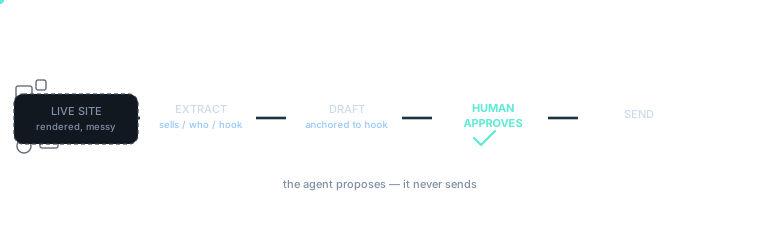
This is not a thought experiment for me; it runs on FarmToYou’s real lead queue. FarmToYou is a marketplace that needs producers on the supply side, which means a standing list of farms, breweries, and small food businesses to reach out to. Each producer in the queue carries a website, and the agent works the queue one producer at a time. Per producer it does four things:
- Reads the live site and extracts what they actually grow or make, who they sell to, and how they sell today, whether that is a CSA, a farmers’ market, wholesale to restaurants, or their own storefront.
- Writes the opener anchored to that specific read, in the voice of our actual outreach, not a generic template tone.
- Flags poor-fit prospects, the wholesale-only operations or county-only delivery businesses a marketplace like ours cannot serve, so they are never emailed at all.
- Hands a drafted, sourced email to a human to approve before anything sends. The agent proposes; it never blasts.
What "reading the site" actually involves
The phrase "the agent reads the website" hides most of the engineering. Real small-business websites are messy. Some are a single page, some are a sprawl of seasonal updates, some bury the actual product behind a wall of stock photography and a social embed, and a meaningful fraction are JavaScript-heavy storefronts where the useful text is not in the initial HTML at all. The fetch-and-extract layer has to handle that variety without falling over, pull the human-readable content, and ignore the navigation chrome and boilerplate that would otherwise drown the signal. Getting this layer right matters more than any prompt cleverness downstream, because everything the agent later "knows" about a producer arrives through it. If the read is thin or wrong, the rest of the pipeline confidently produces a thin or wrong email.
A structured read, not a vibe
The agent does not return a paragraph of impressions. It returns a structured read: product category, who they sell to, current sales channels, region, and a fit assessment, each as a discrete field. Two reasons. First, structure is what lets the downstream steps act, the fit field gates the send, the channel field shapes which email workflow they land in, and you cannot branch on a vibe. Second, structure is what makes the agent auditable. When I look at why a particular producer got a particular opener, I can see the exact facts it pulled, instead of trusting a black box. The tool is designed so that any field it cannot actually find on the site comes back empty rather than guessed, which turns out to be the single most important design decision in the whole system.
Writing the opener, in our voice
With a real structured read in hand, drafting the opener is the easy part, but it is easy to do badly. The trap is producing something that is technically personalized and tonally robotic, the uncanny-valley email that name-drops a detail in a voice no human would use. So the drafting step is anchored to our actual outreach voice, the same plain, specific register we would use on a call, and it is pinned to the facts in the structured read rather than free to embroider. The output reads like a person who did their homework, because in a real sense one did. The homework just happened at machine speed.
The filter that matters most
The most valuable thing the agent does is decide who not to email. A marketplace like FarmToYou cannot serve a wholesale-only operation or a producer who delivers to one county, and emailing them anyway is worse than useless. It burns sender reputation, it trains the recipient to ignore you, and at volume it drags down deliverability for everyone you do want to reach. So the fit assessment is not a nicety, it is a deliverability control. Every poor-fit prospect the agent quietly removes is one fewer irrelevant send aging your domain. Protecting the sender reputation by not sending does more for reply rates than any subject-line trick ever will, and it is the kind of discipline that is almost impossible to hold by hand when there is a list in front of you and a quota in your head.
A human still approves the send
Nothing the agent writes goes out on its own. It hands a drafted, sourced email to a human, and a person approves it before it sends. This is not timidity, it is the correct shape for the system at this stage. The agent is fast and tireless and occasionally confidently wrong, and a human reviewing a pre-drafted, pre-sourced email can clear a large batch quickly while still catching the read that went sideways. The economics still work overwhelmingly in your favor: the expensive cognitive work, reading each business and drafting a genuine opener, is already done, and the human is left with the one thing humans are still better at, judgment about whether this particular message is true and worth sending.
The catch, stated plainly
This is only an upgrade if the read is real and the output clears a bar, and that condition is doing a lot of work. The failure mode of AI outbound is not the old generic spam. It is confident, specific, wrong spam, produced at scale, and that is strictly worse than a mail-merge, because it is more believable and therefore more damaging when it is off. An email that confidently praises a farm’s "award-winning cheese" when they do not make cheese does not just fail to land, it actively tells the recipient you are running a machine that hallucinates. Everything in the design exists to prevent that one outcome.
The eval loop that keeps it honest
Two mechanisms keep it from going wrong at scale. The first is the tool surface: the read tool is built so the agent can and does return "I could not find this" instead of inventing a plausible answer, and the drafting step is pinned to those returned facts. An agent that is allowed to say "I do not know" is dramatically safer than one that treats every field as mandatory. The second is an eval loop. Before any batch goes wide, a sample of drafts is checked against the source sites: are the claimed facts actually on the page, is the fit call correct, would a human have written something defensibly similar. That sample is how I catch drift early, when a site format starts breaking the extractor or the drafts begin sliding toward a tic, instead of discovering it after a few hundred wrong emails have already shipped. If you cannot measure the output against the source, you are not personalizing at scale, you are hallucinating at scale, and the eval loop is the line between the two.
What is actually scarce now
The constraint that shaped outbound for a generation, choose volume or relevance, is gone. But constraints do not disappear, they move, and it is worth being honest about where this one went. What is scarce now is not the reading or the drafting; the machine does both. What is scarce is taste: the judgment about which prospects deserve a send at all, and whether the specific personalized line is actually true and actually good. The agent has made the expensive part cheap, which means the cheap part, deciding what is worth saying and to whom, is now the entire game. The teams that win with this will not be the ones who send the most personalized emails. They will be the ones whose bar for "good enough to send" is highest.
The takeaway
Personalization at scale stopped being an oxymoron, but it did not stop requiring judgment, it relocated it. The machine reads every prospect and drafts every opener, the work that used to gate the whole motion behind human reading speed. Deciding what is worth saying, to whom, and whether the line is actually true, that stayed human, and on a good system it is where almost all the remaining leverage lives. Build the read so it can admit ignorance, build the eval loop so wrong-at-scale cannot hide, and keep a person on the send. Do that and you get the thing outbound chased for twenty years. Skip it and you have just automated the fastest way to burn a domain.
Anthropic Claude, web read/extract tooling, Postgres lead queue, human-in-the-loop approval, eval sampling.
- Agents
- Outbound
- Anthropic Claude